
Last updated September 10, 2026
Full 25-point door and opener safety check with every visit - springs, cables, rollers, tracks, and your LiftMaster or Chamberlain opener included
You get a price before we start. It does not change when the truck arrives.
 Before
 After
After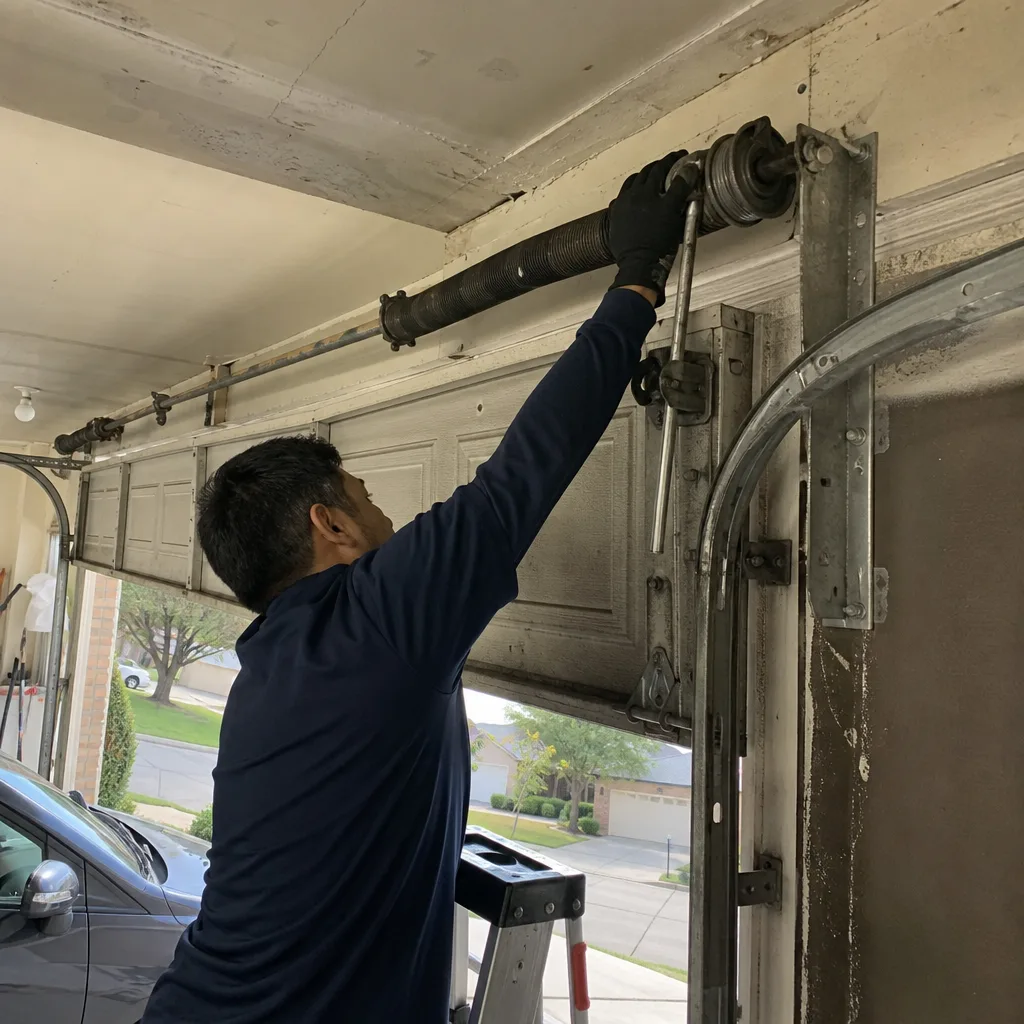 Before
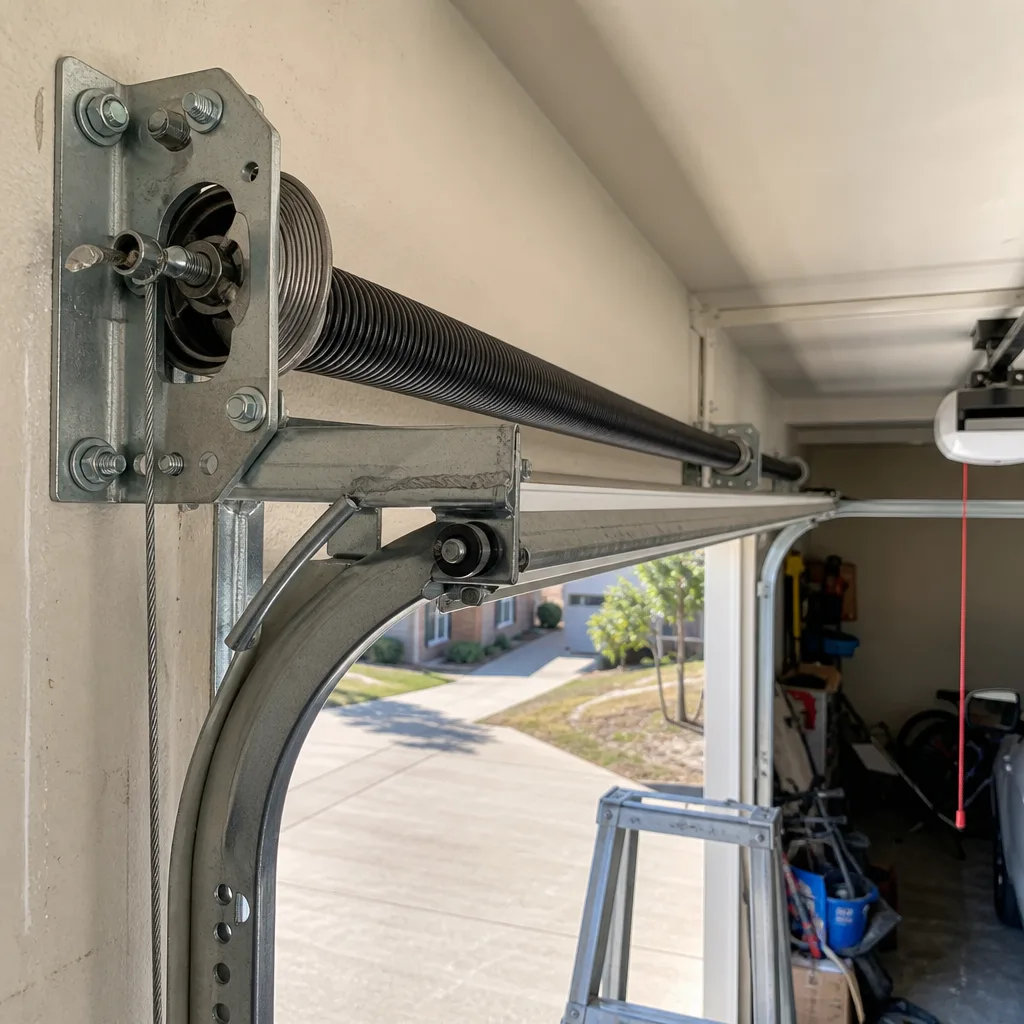 After
After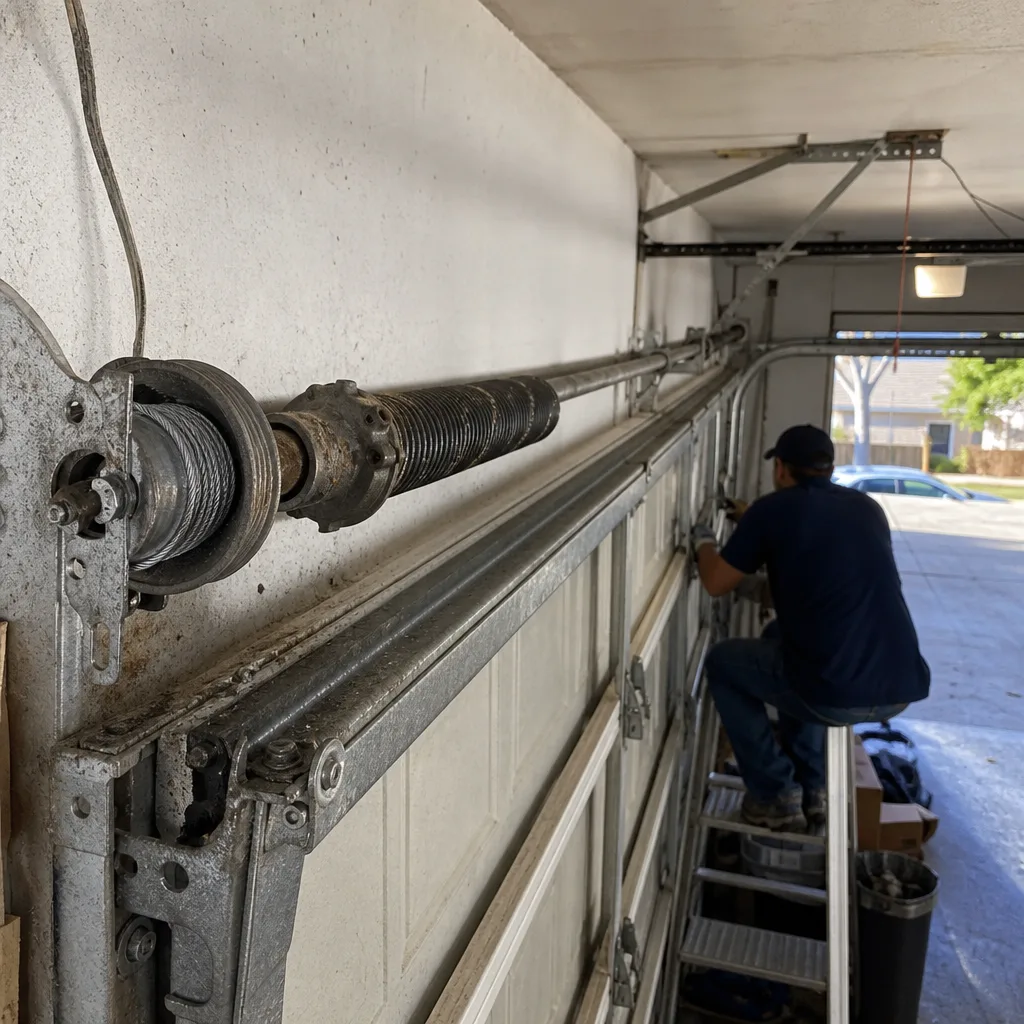 Before
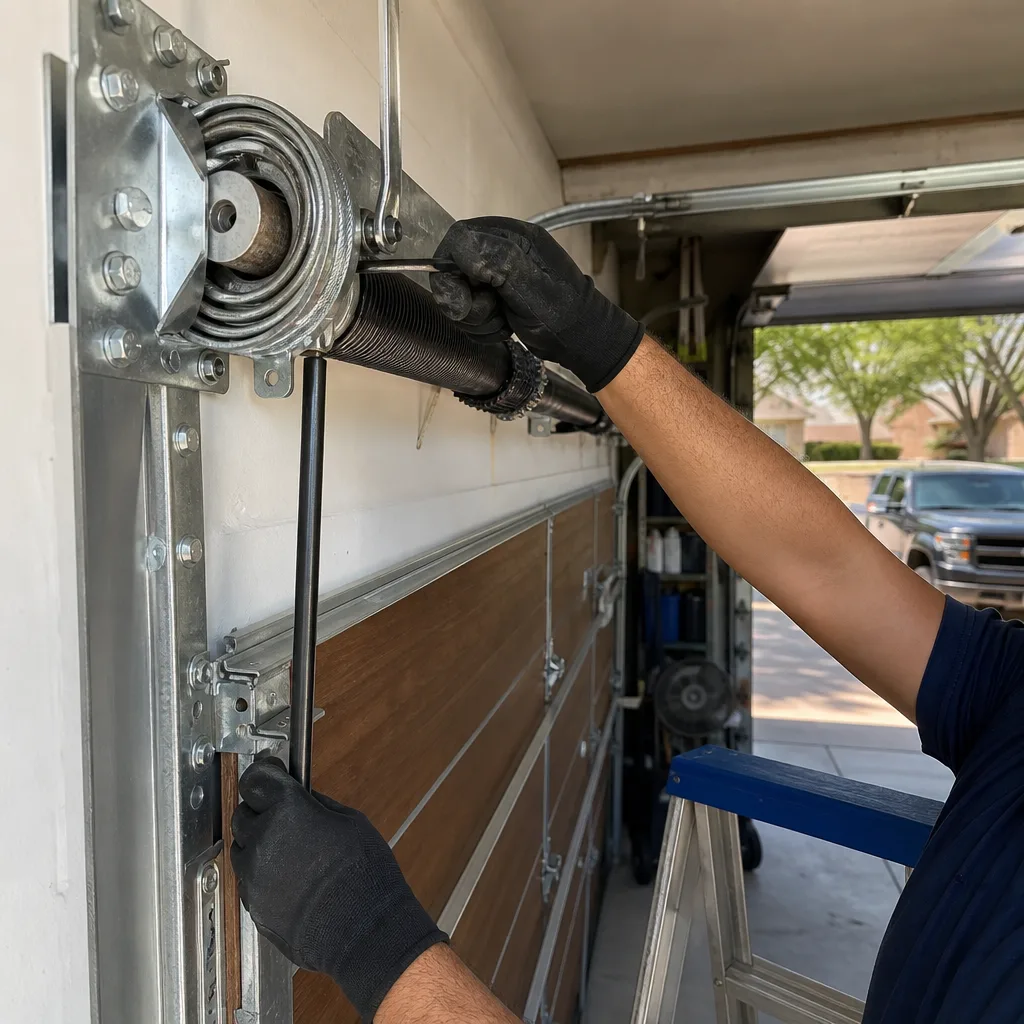 After
AfterGarage Door Warning Signs: A Lewisville Homeowner’s Reference Guide
A grinding noise when your door moves isn’t annoying - it’s your door telling you a roller bearing is seizing, and you’ve probably got two weeks before it jams hard enough to trap your car inside. Most Lewisville homeowners don’t get blindsided by garage door failures. They get warned. The signs are there for weeks - in the way the door hesitates, the pitch of the squeal, the rust streak spreading across the bottom panel. The problem is that nobody ever taught you what those signs mean. This guide does. We’re going to walk through the exact sounds, movements, and visual cues our team looks for in the first sixty seconds of a service call in Lewisville, so you can spot trouble before it spots you.
Quick Answer
The most common garage door warning signs in Lewisville are grinding or squealing noises from worn rollers, a door that rises unevenly or hesitates midway, visible rust streaking along the bottom panel, and a slow response when you hit the opener button. Any of these means the door needs attention within days, not months - and a few of them mean the spring is about to let go. If you notice one, call (945) 777-4998 for a straight answer about what you’re hearing.
Table of Contents
- The Sound Identification Key: What Your Door Is Saying
- Uneven Door Movement: Reading the Mechanical Story
- The Bent Track Test: Why You’re Probably Misreading the Problem
- The Slow Door: Opener Strain or Spring Failure?
- Rust Streaking on the Bottom Panel: Lewisville’s Most Ignored Warning Sign
- The 8-Point Visual Inspection You Can Do This Weekend
- Common Mistakes to Avoid
- When to Call a Professional
- Frequently Asked Questions
- The Bottom Line
The Sound Identification Key: What Your Door Is Saying
Here’s the thing about garage doors: they talk. Every noise they make corresponds to a specific component, and most of those components are cheap to fix if you catch them early and brutal on the wallet if you don’t. In Lewisville, where temperature swings make metal expand and contract through the year, we hear the same four sounds over and over - which is why seasonal garage door care for Lewisville matters. Here’s how to read them.
Sound 1: The Snap
A snap is not a warning. A snap is the sound of something that already broke. When a torsion spring fails, the sound is sharp and loud - homeowners describe it as a gunshot from the garage, a firecracker, or someone hitting the wall with a hammer. The door will not open by hand after this. It may not even move. Do not try to force it. A door is roughly 200 pounds riding on two springs; if one spring is broken, the opener is trying to lift that weight alone, and either the opener burns out or the cable snaps. Neither is a good Tuesday.
If you hear a snap, stop using the door. Call a professional. The fix is a spring replacement, and it is not a DIY job. These springs carry enough tension to remove fingers or worse. Otto’s Garage Door Repair in Lewisville covers broken springs same-day, and a live person answers the phone around the clock - including nine at night when the spring lets go and your vehicle is sealed inside.
Sound 2: The Grind
A grinding noise means a roller bearing is failing. The roller is the small wheel that rides inside the track; when its internal bearing seizes up, the wheel stops rolling and starts dragging metal against metal. That’s the grind.
Grinding is not urgent-urgent the way a snap is, but it is on a timer. We usually see a grinding roller go from noisy to jammed in ten days to three weeks. When it jams, the door can bind hard enough to stress the cable, bend the track, or stall the opener mid-cycle. The repair for a grinding roller is a twenty-minute swap. The repair for a door that jammed hard enough to damage the track is a different conversation entirely.
One way to make sure? Take a look at the roller while the door is closed. If the wheel is flat-spotted or wobbles when the door moves, it is done. Replace it before it replaces your schedule.
Sound 3: The Pop
A pop is usually a cable issue. When a cable strand starts to fray, the individual wires snap one at a time under tension. That popping or crackling sound you hear as the door moves is the cable losing strands. This is one of the most dangerous warning signs on this list, because a cable that loses enough strands will snap completely while the door is in motion. When that happens, the door can drop hard and fast.
A frayed cable often looks like a wire brush near the bottom bracket. If you see that, do not run the door. Have someone come look at it. This is a case where the fix is straightforward for a pro with the right winding tools and the sense to respect the tension, and genuinely dangerous for anybody without both.
Sound 4: The Squeal
A squeal can be two things. The harmless version is a hinge or roller that needs lubrication; a quick shot of garage-door lubricant on the hinge pins and roller bearings clears that up fast. Use a lubricant made for garage doors, by the way. WD-40 is a solvent, not a lubricant, and it will strip grease off the hinges and make the problem worse.
The less harmless version of a squeal comes from the opener itself. If the squeal is loudest while the opener motor is running and the sound changes pitch as the door moves, the opener’s drive gear may be stripping. LiftMaster, Chamberlain, Genie, and Craftsman openers all have plastic drive gears that wear over time - it’s a by-design sacrificial part, but once it stops gripping, the door quits moving entirely. As we like to say around the shop: if the opener is straining, the problem is almost never the opener. But if the opener is squealing, sometimes it is.
Uneven Door Movement: Reading the Mechanical Story
When a door rises unevenly - one side higher than the other, or the door tilts slightly as it goes up - the cause is almost always one of three things. Here’s how to tell them apart.
- Tension imbalance. The two springs on either side of the door are supposed to carry equal tension. When one spring has lost tension (or has broken while the other holds), the door lifts harder on one side and tilts. If the door has seemed heavier lately and it tilts to one side as it rises, you are looking at a spring that is losing tension. On a cold morning, that spring is likely to finish breaking. We count spring cycles the way you count tire miles - a standard torsion spring is rated for about 10,000 open-and-close cycles, which works out to eight to twelve years in a typical Lewisville household. If your springs are near that age and the door is tilting, it’s time.
- Cable slip. If one cable has slipped on its drum, the cable on that side is effectively shorter than the other. The door rises lopsided regardless of spring condition. Cable slip often follows a frayed cable or a loose drum set screw, and it can happen suddenly - a door that was fine yesterday tilts hard today. This one is a safety issue, because the cable is the only thing holding tension on that side. Do not attempt to adjust it yourself. The tension in a wound torsion spring assembly will break fingers, wrists, and worse if it releases against you.
- Track obstruction. Sometimes the uneven movement is something dumb: a shovel leaning against the track, a leaf blower strap wrapped around a roller, or a curb or floor crack that shifted the track alignment. Inspect the track on both sides before you assume the worst. If the door binds at a specific point in its travel and then frees up, you probably have an obstruction or a bent track section, not a spring problem.
Here’s a tip most guides miss: the side that lags - the side that sits lower as the door rises - is the side with the problem. If the left side lags, look at the left spring, left cable, and left track first. The lagging side tells you where to look, every time.
The Bent Track Test: Why You’re Probably Misreading the Problem
Here’s a scenario we see at least twice a month in Lewisville: a homeowner calls to say their door panel is bent or the door is “coming apart” because they can see a gap between the panel and the track. They’ve already priced a new panel. Almost every time, the panel is fine. The track is bent, and the gap they’re seeing is the door being pulled away from the track at that point.
This distinction matters because the repair costs are nowhere close. Realigning or replacing a bent track section is a fraction of the cost of replacing a door panel - sometimes an eighth, sometimes less. If you misread the problem and order a panel, you’re paying for a part that doesn’t need replacing and you still have a bent track.
The test: open the door halfway and look at the gap between the roller and the track channel on each side. The roller should sit tight in the track with almost no side-to-side play. If the gap widens and narrows as the door moves, the track has a bent section. If the gap is consistent the whole way, the panel or its hinges are the problem. That’s the sixty-second version. This is exactly the kind of diagnostic conversation we have on the phone - someone describes what they’re seeing, we ask two questions, and they know whether they’re looking at a track adjustment or a panel replacement.
Bent tracks in Lewisville happen three ways: someone backs into the door while it’s closing, a heavy bike or lawn equipment falls against the track, or thermal expansion in an uninsulated garage pushes the track out of alignment over time. The first two are obvious. The third one builds slowly over years, which is why a track that was fine when the house was built is now pinching the door in August. If you catch it while it’s still a misalignment, the fix is usually a re-level and a re-secure of the track brackets. Wait until the door jams hard and you might be replacing the section.
The Slow Door: Opener Strain or Spring Failure?
A door that responds slowly to the opener button - call it a two-second delay between the button press and the motor starting, or the door itself crawling up the track - is a sign that either the opener is working too hard or the springs are not doing their half of the job. Most people assume it’s the opener. Often it’s not.
Here’s the mechanics: a garage door spring is designed to carry the weight of the door through its travel. The opener is designed to provide the motion, not the lift. When a spring loses tension, the door gets heavier. The opener picks up the slack for as long as it can, but the extra load wears the drive gear, the motor, and the chain or belt. The first sign is a slower door. The second sign is a dead opener. The third sign is the spring finally snapping on a cold Lewisville morning, which usually happens right after you’ve paid for a new opener and think the problem is solved.
If your door is slow, test it this way: pull the emergency release cord and lift the door by hand. A properly balanced door should rise smoothly with moderate effort and stay in place about halfway up when you let go. If the door feels heavy, wants to fall when you release it, or takes serious muscle to lift, the springs have lost tension. The opener is not the culprit - it’s the victim. Replacing the opener without fixing the spring kills the new opener within two years and costs you twice. If the opener is straining, the problem is almost never the opener.
That said, if the door lifts fine by hand and the opener is still slow, then you are looking at an opener that is under-powered for the door size, aging, or has a failing capacitor. A 1990s-era Craftsman opener on an insulated 16-foot Clopay door is not a great match - the door outweighs what the motor was built for. Either way, the diagnosis starts with the hand-lift test. It costs nothing and tells you which half of the system is failing.
Rust Streaking on the Bottom Panel: Lewisville’s Most Ignored Warning Sign
If you live in one of Lewisville’s older subdivisions - the homes built in the 1980s and early 1990s where garages sit low to the slab and the North Texas humidity finds its way in - you may have seen rust-colored streaks running down from the bottom edge of your door panel. Homeowners ignore this one for years. They assume it’s cosmetic. It is not.
Rust streaking on the bottom of a door panel means water is sitting against the panel bottom weatherstripping and wicking up into the panel’s internal structure, or the panel’s bottom rail has already begun to rust through from the inside. The streaks are the rust visibly bleeding out. By the time you can see the streaks, the bottom rail is usually soft, and a soft bottom rail means the panel no longer seals against the weatherstripping, which lets more water in, which rusts the rail faster. It’s a slow-motion loop, and it ends with a panel that crumbles at the bottom edge and needs replacing.
There is a harmless version of this: surface rust on the steel from years of weather, which a wire brush and some primer can stop. The dangerous version is the rust coming from inside the panel. You can tell the difference with a fingernail. Surface rust is rough on the surface but the metal underneath is solid. Internal rust means the bottom rail flexes or crunches when you press it. If it flexes, the panel is losing structural integrity. Catch it early and the fix may be new weatherstripping, a bottom rail reinforcement, and cutting the moisture source. Catch it late and you’re buying a panel.
This is a Lewisville-specific problem because our seasonal humidity and the way older slabs settle let moisture sit at the garage threshold. Drive through neighborhoods near Lake Lewisville and you’ll see the pattern on a dozen doors. The fix is usually simple: check that water drains away from the garage door, replace cracked weatherstripping before each rainy season, and look at the bottom rail every spring. If the rail is already soft, you caught it in time to prevent a full panel replacement - but not by much.
The 8-Point Visual Inspection You Can Do This Weekend
You don’t need a ladder for most of this, and you don’t need to be a mechanic. You need five minutes and a straight eye. Here’s what we look at on every service call in Lewisville, in order.
- The cables. Look at both lift cables, one on each side near the bottom bracket. Frayed strands, kinks, or rust along the cable body means replacement is overdue. Cables do not heal. They break.
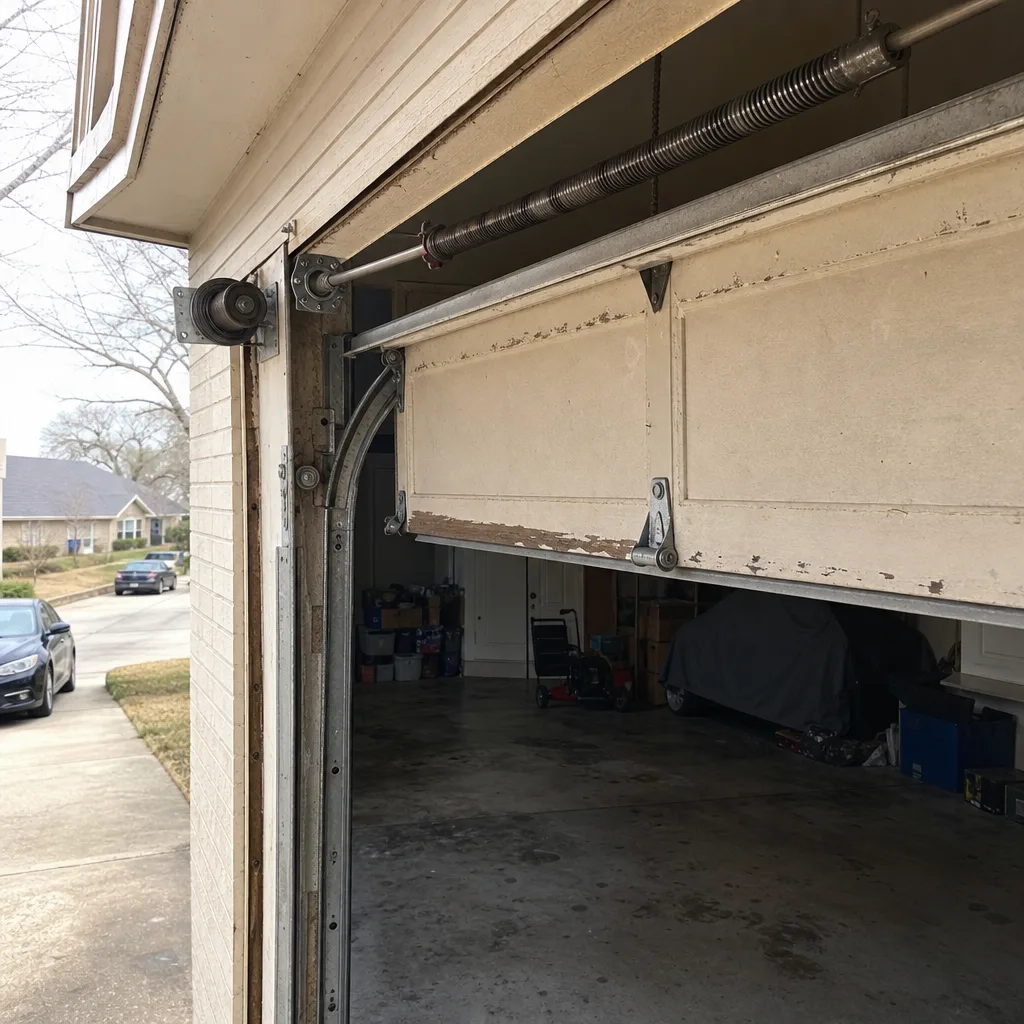
- The springs. If you have a torsion spring system, look above the closed door. If one spring is broken - you’ll see a visible gap in the coil - that’s a replacement call. If you have extension springs on the sides, look for sagging or stretched coils.
- The rollers. With the door closed, look at the rollers where they meet the track. Worn, flat-spotted, or wobbling wheels need replacing. Nylon rollers that show cracks around the bearing are done.
- The track. Run your eye down both tracks. Look for gaps where the track pulls away from the wall, obvious bends, or bracket screws that have backed out. A track that shifts while the door runs is a track that will eventually bind.
- The bottom panel and weatherstripping. Check for the rust streaking we talked about above, and look at the rubber strip along the bottom. If it’s cracked, flattened, or pulling away from the panel, water is getting in.
- The hinges. All the hinges on the door should sit flush and tight. A hinge that is pulled away from the panel or shows a visible gap is starting to fail. Tighten loose hinge bolts while they’re still tight enough to thread.
- The balance. Pull the emergency release and lift the door by hand. It should be manageable, and it should hold around half-open without dropping. If it fights you, the springs are worn.
- The opener. Watch the opener rail while the door cycles. Squealing from the motor, grinding from the chain, or hesitation between the button press and the motor start are all signs the opener is aging out.
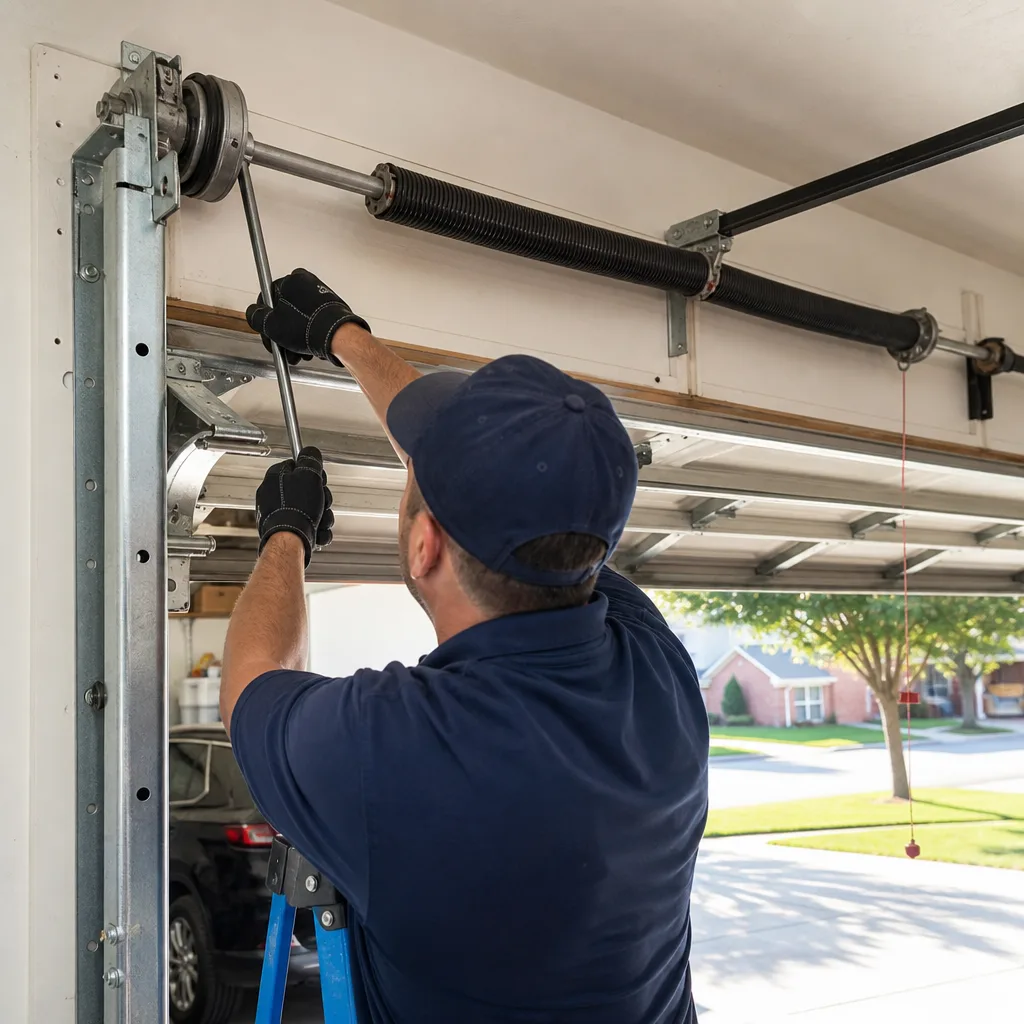
You’ll notice we didn’t say “tighten the spring” or “lube the cables.” Some things on a garage door are homeowner territory. The springs and cables are not. A spring under tension stores enough energy to break bones, and a cable under tension can sever fingers. If your inspection turns up a spring or cable issue, the inspection worked - now put the door down and call someone who has the right tools and the sense to use them.
Common Mistakes to Avoid
- Lubricating a grinding roller and calling it fixed. Grease or lubricant on a seized bearing will quiet it down for a few days and then the grinding comes back louder. The bearing is worn out. Lubricant doesn’t rebuild metal. Replace the roller.
- Assuming a slow door needs a new opener. Nine times out of ten in Lewisville, a slow door is a spring losing tension, and the opener is working harder than it was ever meant to. Replace the spring first, then evaluate the opener. Otherwise you’ll replace the opener twice.
- Using WD-40 on the door hinges and tracks. WD-40 is a solvent that strips grease and attracts dust. What you want is a garage-door-specific lubricant on the hinge pins and roller bearings, and a clean track that doesn’t need lube at all. A greasy track just collects the North Texas dust.
- Ignoring rust streaking because “it still opens.” The door works fine right up until the bottom rail collapses. Rust is not a cosmetic problem on a steel panel any more than it is on a car frame. Check the rail.
- Misreading a bent track as a bent panel. We covered this above, but it’s worth repeating because it’s the most expensive misread on this list. A gap between the panel and the track is usually a track problem. Diagnose it properly before you price a new panel.
- Trying to fix a cable or spring yourself. The YouTube video makes it look manageable. The video does not show the part where the winding bar slips and the spring unloads on your hand. Springs and cables are not a Saturday project. They are the reason pros carry special tools and respect the tension.
- Waiting until the door won’t open to call. By the time the door refuses to move, you’re not just fixing the original problem - you may also be fixing the damage the door caused trying to run while bound, plus whatever the car did when it couldn’t get out. The warning signs in this guide are your window to avoid the cascade.
When to Call a Professional
Some problems on this list you can handle: tightening a hinge bolt, replacing worn weatherstripping, lubricating a squeaky hinge. Most of the rest you should not. Call a professional when you hear a snap, see a frayed cable, find a broken spring, notice the door lagging on one side, or press on the bottom rail and feel it crunch. Any of those means the door’s weight and tension are no longer under control, and that’s the point where a repair attempt becomes a safety hazard.
If you’re in Lewisville and you’re not sure whether what you’re seeing is urgent, call and describe it. A live person answers around the clock, and you’ll get a straight answer about what the sound means and whether it can wait. Otto’s Garage Door home is local, owner-operated, and has been serving this county since 2004. The phone number is (945) 777-4998. Estimates are free, and if we quote a price on the phone, that price holds at the door.
Frequently Asked Questions
In Lewisville, you can expect to pay between $180 and $340 to replace a single torsion spring, and between $280 and $500 to replace a pair, depending on the spring’s size, cycle rating, and the door’s weight. At Otto’s Garage Door, we quote the job on the phone and hold that number when we arrive - the price is agreed before any work starts, and it doesn’t change. Call (945) 777-4998 for an exact quote on your door; estimates are free.
Yes. Otto’s Garage Door runs same-day repair service across Lewisville and the surrounding county, and a live person answers the phone 24 hours a day. If a spring snaps at nine at night and your car is sealed inside, you’ll get Otto or a member of his crew on the line, not a call center. Same-day repair means exactly that. Call (945) 777-4998 and we’ll tell you when we can be there.
A squeak alone is not dangerous - it usually means a hinge or roller needs lubrication, or an opener gear is wearing. The danger is when the squeak is accompanied by uneven movement, a door that shakes, or a pop sound, which points to cables or springs under failing tension. If you are not sure which sound you are hearing, call Otto’s Garage Door and describe it. We’ll tell you whether it can wait.
Do the hand-lift test: pull the emergency release and lift the door by hand. If it’s heavy or wants to drop, the spring has lost tension and that’s your problem - not the opener. If the door lifts easily by hand but the opener is slow, the opener may be under-powered or aging. Either way, call (945) 777-4998 and we’ll diagnose it free of charge.
A broken torsion spring sounds like a gunshot, a firecracker, or someone hitting the wall with a hammer inside your garage. If you hear that sound and the door won’t open, stop using the door and call a professional. The spring is loaded with enough tension to cause serious injury if you try to force the door or fix it yourself. Otto’s Garage Door handles broken spring repair same-day across Lewisville - call (945) 777-4998.
Yes. Lewisville’s summer heat and humidity accelerate rust on door bottoms and spring corrosion, and our winter temperature swings push aging springs to break on cold mornings. Rust streaking on the bottom panel is the most common Lewisville-specific warning sign we see, especially in older neighborhoods near Lake Lewisville. Check your door’s bottom rail every spring. If it flexes under finger pressure, call before the panel needs replacing.
The Bottom Line
Your garage door tells you when it’s failing. The snap means a spring is already gone. The grind means a roller is seizing. The pop means a cable is fraying. The uneven rise tells you which side to look at, and the rust streak tells you water is winning. None of these signs is subtle once you know what you’re hearing and seeing - and catching any of them early is the difference between a hundred-dollar fix and a thousand-dollar cascade. For a door that needs professional attention, Garage Door Installation in Lewisville is the service we offer for full teardown and replacement when the time comes, and if the opener is part of the problem, see our Garage Door Opener in Lewisville page for what to expect. We’ve been in this county since 2004, and Otto is a palindrome: reads the same from either end, same as the door. Call (945) 777-4998 and tell us what your door is saying. We’ll tell you what it means.
Written by Otto Reinhardt, Owner at Otto’s Garage Door, serving Lewisville since 2004.